SPAM NOTES:
a law blog covering electronic communications,
email, social networks, privacy, and more
a law blog covering electronic communications,
email, social networks, privacy, and more
Electronic Communications, Privacy, Data Protection, and More
Why the Hand-Wringing Over the Outed Google "Skank" Blogger?
Good question...I don't know. More importantly, is it blogger, or "blogress" (or "blogess")? Ben S. calls her the "authoress," so I figure one of these variations work.
Seriously, the basic story of this thing that spiraled out of control and became a media event is that someone created a blog called "Skanks in NYC" on Google's blogger platform. Anonymously. The blog contained some nasty things about model Liskula Cohen. Ms. Cohen sued, or more accurately, sought "pre-action discovery" in New York. The author (Rosemary Port) contested the discovery, which sought the identity of the author. A judge in New York found the posts to be sufficiently nasty to allow the discovery. Next thing you know, the author (Ms. Port) says she's going to sue Google for revealing her identity. This should have been dismissed out of hand as mere ranting, but instead brought about a flurry of reports which actually speculated as to the merits of the author's claims. As Ben Sheffner notes at his blog here, those claims have little or no chance of success.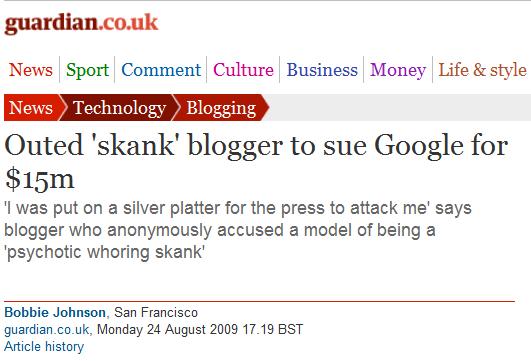
So back to basics for a moment on the anonymous blogging front. You have the right to make your views known anonymously, such as through leafletting. Courts quickly concluded that this extends to the internet as well (Doe v. 2TheMart). The right to post anonymously is not absolute, and if the person seeking your identity makes a sufficient showing, you will be unmasked. There are lots of procedural niceties and technicalities around how this works, but the bottom line (in common sense terms) is that if what you say is nasty enough (and not protected speech) don't expect to remain anonymous. There's also the matter that you may not - technically speaking - be as anonymous as you think you are.
So how did this play out in this case? Exactly as it should have. The person seeking the information was forced to make some sort of showing as to the viability of the underlying claims, the anonymous author (or authoress) was given the opportunity to defend herself and resist the outing, and ultimately, the court concluded that unmasking was appropriate. Dan Gillmor makes this point at Citizen Media Law Project here.
On the flip side, privacy expert Dan Solove thinks that additional procedural requirements (and a higher bar) are appropriate. I'm not sure forcing a person seeking a poster's identity to jump through the summary judgment hoops makes any sense, but I don't think this would have really changed anything in this case. And that's ultimately what we should take away from this episode. If you post stuff that's sufficiently nasty, you are likely to be unmasked. As with everything else in the law, the "reasonableness" standard is the anchor, and Ms. Port comes across as hopelessly unmoored from this standard.
A strange post-script to this story is that Ms. Cohen and Ms. Port are actually acquaintances, and after learning the identity of the poster Ms. Cohen decided to take the high road and not pursue any claims. Strange.
Seriously, the basic story of this thing that spiraled out of control and became a media event is that someone created a blog called "Skanks in NYC" on Google's blogger platform. Anonymously. The blog contained some nasty things about model Liskula Cohen. Ms. Cohen sued, or more accurately, sought "pre-action discovery" in New York. The author (Rosemary Port) contested the discovery, which sought the identity of the author. A judge in New York found the posts to be sufficiently nasty to allow the discovery. Next thing you know, the author (Ms. Port) says she's going to sue Google for revealing her identity. This should have been dismissed out of hand as mere ranting, but instead brought about a flurry of reports which actually speculated as to the merits of the author's claims. As Ben Sheffner notes at his blog here, those claims have little or no chance of success.
So back to basics for a moment on the anonymous blogging front. You have the right to make your views known anonymously, such as through leafletting. Courts quickly concluded that this extends to the internet as well (Doe v. 2TheMart). The right to post anonymously is not absolute, and if the person seeking your identity makes a sufficient showing, you will be unmasked. There are lots of procedural niceties and technicalities around how this works, but the bottom line (in common sense terms) is that if what you say is nasty enough (and not protected speech) don't expect to remain anonymous. There's also the matter that you may not - technically speaking - be as anonymous as you think you are.
So how did this play out in this case? Exactly as it should have. The person seeking the information was forced to make some sort of showing as to the viability of the underlying claims, the anonymous author (or authoress) was given the opportunity to defend herself and resist the outing, and ultimately, the court concluded that unmasking was appropriate. Dan Gillmor makes this point at Citizen Media Law Project here.
On the flip side, privacy expert Dan Solove thinks that additional procedural requirements (and a higher bar) are appropriate. I'm not sure forcing a person seeking a poster's identity to jump through the summary judgment hoops makes any sense, but I don't think this would have really changed anything in this case. And that's ultimately what we should take away from this episode. If you post stuff that's sufficiently nasty, you are likely to be unmasked. As with everything else in the law, the "reasonableness" standard is the anchor, and Ms. Port comes across as hopelessly unmoored from this standard.
A strange post-script to this story is that Ms. Cohen and Ms. Port are actually acquaintances, and after learning the identity of the poster Ms. Cohen decided to take the high road and not pursue any claims. Strange.
Victim's Facebook Entries Ruled Inadmissible in Assault Case
The Missouri Court of Appeals recently held that the trial judge properly excluded an assault victim's Facebook status updates in a criminal case. (State v. Corwin, Case No. SD29422, Southern District, Division One; August 20, 2009) (h/t Prof. Goldman)
The Basic Facts of the case are that the victim and defendant (and some others) went out and had some drinks. The victim accompanied the defendant to his dorm room where the defendant assaulted or attempted to assault the victim. The defendant's argument at trial was that the victim's recollection of the evening in question was suspect. In seeking to discredit the victim's story, the defendant tried to introduce evidence of the victim's Facebook page, which contained status updates describing the victim's lifestyle, including nights of drinking and mornings where the victim could not remember exactly what transpired the night before. None of the updates related to the evening in question, but one update did state that victim went out one night (some time after the event it seems) and could not remember where she got certain bruises. The trial court excluded the evidence. Although the defendant objected, defendant did not raise this objection in his request for a new trial (or motion for judgment notwithstanding the verdict).
The Court of Appeals reviewed the evidentiary ruling for "clear error," given the defendant's failure to raise this objection at the post-trial phase [harsh!]. The court noted that "the complaining witness in a sex offense case may be impeached by evidence that her general reputation for truth and veracity is bad but not ordinarily by proof of specific acts of misconduct." Ultimately, the court found that the trial court properly excluded the evidence:
***
What to make of this? With the gigantic caveat that I'm not a criminal lawyer, the court's conclusion that stuff relating to her drinking and going out were properly excluded seems sound. This is general reputation evidence that is off limits in an assault case. On the other hand, if the victim had in the past gone out and received bruises that the victim could not recall the details of, this seems like a fair subject of inquiry. And to the extent the victim's response doesn't conform to the Facebook postings, my instinct is that the postings could properly be used to impeach. Maybe it's too collateral? But given the common circumstances between the Facebook posting and the evening in question..The opinion is somewhat convoluted, so it's tough to get a clear sense of what exactly the court is saying should have come in, if anything. Either way, clear error..no luck for defendant. It doesn't seem like the evidentiary ruling made a huge difference one way or the other.
Facebook status updates and postings from other networks are being used more and more in judicial proceedings. There's nothing exceptional about this really, except for the fact that the evidence exists, and is so readily available (it's almost an evidentiary bonanza for lawyers). (I'm curious as to how they obtained the postings here..maybe through a Facebook friend? I would guess Facebook would respond to a subpoena, but I wonder what hoops Facebook would make the lawyers jump through.) Think of it this way. Your diary entries and communications with your friends are typically admissible in a case. In fact, they are some of the best indicators of what you were thinking. And that's exactly what Facebook is. A giant diary of sorts in the sky. Just one that is readily accessible to lawyers. In the old days, opposing counsel may or may not come across your diary. They may not ask you about it. You may not be entirely truthful. Either way, with Facebook, chances are high that if you have a profile, opposing counsel will come across it, and will try to use your postings.
The Basic Facts of the case are that the victim and defendant (and some others) went out and had some drinks. The victim accompanied the defendant to his dorm room where the defendant assaulted or attempted to assault the victim. The defendant's argument at trial was that the victim's recollection of the evening in question was suspect. In seeking to discredit the victim's story, the defendant tried to introduce evidence of the victim's Facebook page, which contained status updates describing the victim's lifestyle, including nights of drinking and mornings where the victim could not remember exactly what transpired the night before. None of the updates related to the evening in question, but one update did state that victim went out one night (some time after the event it seems) and could not remember where she got certain bruises. The trial court excluded the evidence. Although the defendant objected, defendant did not raise this objection in his request for a new trial (or motion for judgment notwithstanding the verdict).
The Court of Appeals reviewed the evidentiary ruling for "clear error," given the defendant's failure to raise this objection at the post-trial phase [harsh!]. The court noted that "the complaining witness in a sex offense case may be impeached by evidence that her general reputation for truth and veracity is bad but not ordinarily by proof of specific acts of misconduct." Ultimately, the court found that the trial court properly excluded the evidence:
Here, the information contained in Exhibit A went beyond any evidence even tangentially related to events of the night in question and detailed prior instances of what could be termed misconduct on the part of Victim. Exhibit A contained quotes, information, photographs, and comments about almost all aspects of Victim's life including references to partying, sex, drinking, schoolwork, and at least one sexually suggestive photograph. None of this information is legally relevant to the fact that Appellant was charged with the attempted forcible rape of Victim. Even the quote at issue relating to an instance some nine months after the event in question where Victim might have received bruises after an evening out on the town is legally irrelevant and is not directed at Victim's reputation for truth and veracity. Evidence that Victim had been bruised on another occasion when intoxicated neither proves nor disproves that her bruises on the day of the attempted rape were from an alcohol related accident, instead of Appellant's violent actions toward her. It was permissible for Appellant's counsel to ask Victim whether she had received bruises in the past after a night of drinking; however, her Facebook profile page was not admissible to challenge her answer on this collateral matter.(emphasis added)
***
What to make of this? With the gigantic caveat that I'm not a criminal lawyer, the court's conclusion that stuff relating to her drinking and going out were properly excluded seems sound. This is general reputation evidence that is off limits in an assault case. On the other hand, if the victim had in the past gone out and received bruises that the victim could not recall the details of, this seems like a fair subject of inquiry. And to the extent the victim's response doesn't conform to the Facebook postings, my instinct is that the postings could properly be used to impeach. Maybe it's too collateral? But given the common circumstances between the Facebook posting and the evening in question..The opinion is somewhat convoluted, so it's tough to get a clear sense of what exactly the court is saying should have come in, if anything. Either way, clear error..no luck for defendant. It doesn't seem like the evidentiary ruling made a huge difference one way or the other.
Facebook status updates and postings from other networks are being used more and more in judicial proceedings. There's nothing exceptional about this really, except for the fact that the evidence exists, and is so readily available (it's almost an evidentiary bonanza for lawyers). (I'm curious as to how they obtained the postings here..maybe through a Facebook friend? I would guess Facebook would respond to a subpoena, but I wonder what hoops Facebook would make the lawyers jump through.) Think of it this way. Your diary entries and communications with your friends are typically admissible in a case. In fact, they are some of the best indicators of what you were thinking. And that's exactly what Facebook is. A giant diary of sorts in the sky. Just one that is readily accessible to lawyers. In the old days, opposing counsel may or may not come across your diary. They may not ask you about it. You may not be entirely truthful. Either way, with Facebook, chances are high that if you have a profile, opposing counsel will come across it, and will try to use your postings.
Twitter's Trademark Travails..Continued
Twitter's trademark issues don't really warrant three or four posts, but..it is what it is (see here, here, here, and here).
Sam J. has a post ("Twitter's 'Tweet' Trademark Torpedoed") that I think adds to the mix:
don't have strong feeling on the issue (probably more accurate to say that I) haven't taken a close look at the issue, it's just been interesting to watch it twist and turn. I don't know that Twitter's efforts are doomed, but they've been pretty inconsistent about messaging, and developers are bound to grumble.
[modified to include an excerpt of Sam's post]
Sam J. has a post ("Twitter's 'Tweet' Trademark Torpedoed") that I think adds to the mix:
IAccording to documents from the Trademark Document Retrieval system, their lawyers (Fenwick & West LLP) were notified of the rejection by email to [email protected] that day. The USPTO had explained that "marksin prior-filed pending applications may present a bar to registrationof applicant’s mark. [...] If the marks in the referenced applicationsregister, applicant’s mark may be refused registration under TrademarkAct Section 2(d) because of a likelihood of confusion between the twomarks", referencing and attaching not one, not two but three separate trademark applications:Now I may not be a lawyer (I did play a role in overturning Dell's "cloud computing" and Psion's "Netbook"trademarks) but given all three of the marks identified look likeproceeding to registration (it only takes one to rain on their parade),it's my non-expert opinion that Twitter has a snowflake's chance in hell of securing a monopoly over the word "Tweet".
- #77695071 for TWEETMARKS (pending receipt of Statement of Use)
- #77697186 for COTWEET (pending clarification)
- #77701645 for TWEETPHOTO (pending transfer to Supplemental Register)
[modified to include an excerpt of Sam's post]
What to Make of Lanier's Privacy Lawsuit Against Facebook?
TechCrunch and others recently reported on a multi-count, multi-plaintiff lawsuit filed against Facebook in California (Scribd link to the lawsuit here). TechCrunch thinks it's pretty flimsy. I'm not sure what to think.
Quick comments:
Quick comments:
- The complaint almost reads like a laundry list of facts about Facebook. For example, the complaint mentions that Facebook bought FriendFeed. So?
- It doesn't seem like plaintiffs are complaining about any one thing. There's no real smoking gun that's driving this lawsuit. At least, it doesn't seem like it after reading the complaint. It's also odd that they are complaining about Beacon when there's already a beacon lawsuit going on (actually there are several).
- There's a claim about Facebook datamining, but it seems to be factually based on an advertisement or advertisements by Facebook calling for applicants to a data analyst position (?).
- What about the California Online Privacy Protection Act? This statute (summary here) is not really that strong of a club, in my opinion, and only requires certain entities to post a privacy policy describing policies regarding data collection and use...30 days after being notified of non-compliance. (There are other aspects to this law, but the fact that there are no notable cases brought by plaintiffs under this statute several years after its enactment is telling.)
- The most colorable claims seem like the publicity and personality driven claims - which allege that Facebook exploited the personality and publicity rights of users without permission. Resolution of this claim will involve digging into (the various versions of) Facebook's terms, the enforceability of click and browsewrap agreements, whether the terms were unconscionable (etc.). This process will not be fun for Facebook, and I'm hoping they've done a good job of keeping track of which set of users agreed to which version of the terms. Also, there was a furor over people unwittingly appearing in Facebook ads, including a woman whose husband was served with a singles ad featuring the woman, but the complaint didn't seem to highlight this much.
- The complaint doesn't seek class action status.
This confirms my mildly informed bystander observations that Lanier gets results...big ones. Lawyers of this ilk typically have "strategies" around litigation. They don't litigate individual cases as such...they take a long-term view of litigation. And more than anything, this should worry Facebook.In 2005, Lanier won a $253 million jury award against Merck & Co.Inc. for the widow of a man who died after taking the company's drugVioxx. The verdict was later reversed on appeal.
Lanier alsowon a verdict of more than $115 million in an asbestos case. He alsowon a $480 million dollars in a business fraud case.
Gordon v. Virtumundo: 9th Cir Smacks Down Anti-Spammers in Trifecta Defense Win
The 9th Circuit issued its long awaited opinion in Gordon v. Virtumundo, and "wow," is all I can say! It's a resounding win for Virtumundo and picks up where Mummagraphics left off - the anti-spam community suffers a crushing defeat. Access the opinion here [pdf]. Congrats to Derek Newman and Randall Moeller (of Newman & Newman) counsel for Virtumundo. As far as opinions go, this is as good as it gets.
Quick background: Gordon was one of the many plaintiffs who were not ISPs in the traditional sense but brought claims under CAN-SPAM. He (and his ISP) sued Virtumundo alleging claims under CAN-SPAM and under Washington's email statute. After extensive discovery, the district court (Judge Coughenour, who rightly gets props in the Ninth Circuit opinion) granted summary judgment for Virtumundo, finding that Gordon had not suffered adverse effects under CAN-SPAM and that his claims under the Washington email statute were preempted. Gordon appealed, proceeding pro se, and then picking up a lawyer along the way. The Ninth Circuit resoundingly rejected his appeal, finding that he was not a "bona fide" ISP who could sue under CAN-SPAM, he had not suffered adverse effects under the statute, and his claims under the Washington statute were preempted. The Washington State Attorney General filed an amicus brief arguing against preemption and the Ninth Circuit pretty much rejected the AGs arguments as well. The Ninth Circuit opinion also had some choice words for the anti-spam community, echoing what I've been saying here for some time: anti-spammers could muck things up for everyone.
Was Gordon the Provider of an Internet Access Service: The first question the Ninth Circuit tackled was whether Gordon was an ISP at all under the statute. Surprisingly, the court held that he wasn't. There is a wealth of precedent finding an extremely low bar for ISP status, but the court nevertheless finds that Gordon is not a "bona fide" ISP. The court smartly acknowledges that the landscape has changed since the enactment of CAN-SPAM, and if all you need to do is to provide email addresses for someone, pretty much everyone, including average consumers can satisfy the definition of ISP. Several facts influenced the court's conclusion, but two stand out. First, the rabid nature of the anti-spam community didn't do much to sway the court:
Was Gordon Adversely Affected: With respect to whether Gordon suffered "adverse effects," the court agreed with the district court that Gordon suffered harm as a typical consumer, and didn't suffer any ISP-specific harm that was caused by the emails at issue. With respect to this issue, the court found Gordon's zeal particularly uncompelling, in fact, as with the ISP issue, it pretty much undermined his cause:
Were Gordon's State Law Claims Preempted: On the issue of whether Gordon's state law claims were preempted, the Washington AG argued that the Washington email statute only extended to "acts of deception." Gordon basically brought flimsy claims under the state email statute arguing that Virtumundo's use of vanity email addresses violated Washington email statute because no actual person existed which used the email address in question. (I never understood Gordon's argument here honestly, but either way, the court rejects Gordon's interpretation of the Washington email statute.) The Washington AG tried to argue for a nuanced resolution of the issue, seeking to preserve the viability of the state email statute, but after the court's decision in Virtumundo, things seem pretty murky on the Washington email statute front. The preemption discussion is interesting also because it cites to Altria Group, a recent US Supreme Court preemption case, to bolster its conclusion. The court also endorses the Fourth Circuit's conclusion in Mummagraphics.
Judge Gould issued a concurring opinion, which can be summed up as follows: "you don't get to sue if you brought about the harm in question."
****
This is a packed up opinion with a lot of implications. There are a slew of pending cases that will likely be touched by this (Asis, Kleffman, etc.). At a basic level, the 9th Circuit's resounding rejection of the "litigation factory" approach to CAN-SPAM litigation is appropriate. As to whether the decision will affect the ability of typical ISPs to bring claims, I'm not sure.
More later. I'm curious to see what the usual suspects have to say! (Prof. Goldman; Jeff Neuburger)
Quick background: Gordon was one of the many plaintiffs who were not ISPs in the traditional sense but brought claims under CAN-SPAM. He (and his ISP) sued Virtumundo alleging claims under CAN-SPAM and under Washington's email statute. After extensive discovery, the district court (Judge Coughenour, who rightly gets props in the Ninth Circuit opinion) granted summary judgment for Virtumundo, finding that Gordon had not suffered adverse effects under CAN-SPAM and that his claims under the Washington email statute were preempted. Gordon appealed, proceeding pro se, and then picking up a lawyer along the way. The Ninth Circuit resoundingly rejected his appeal, finding that he was not a "bona fide" ISP who could sue under CAN-SPAM, he had not suffered adverse effects under the statute, and his claims under the Washington statute were preempted. The Washington State Attorney General filed an amicus brief arguing against preemption and the Ninth Circuit pretty much rejected the AGs arguments as well. The Ninth Circuit opinion also had some choice words for the anti-spam community, echoing what I've been saying here for some time: anti-spammers could muck things up for everyone.
Was Gordon the Provider of an Internet Access Service: The first question the Ninth Circuit tackled was whether Gordon was an ISP at all under the statute. Surprisingly, the court held that he wasn't. There is a wealth of precedent finding an extremely low bar for ISP status, but the court nevertheless finds that Gordon is not a "bona fide" ISP. The court smartly acknowledges that the landscape has changed since the enactment of CAN-SPAM, and if all you need to do is to provide email addresses for someone, pretty much everyone, including average consumers can satisfy the definition of ISP. Several facts influenced the court's conclusion, but two stand out. First, the rabid nature of the anti-spam community didn't do much to sway the court:
Ouch. Second, Congress wanted to allow for a right of action for a select group of private plaintiffs, and lawmakers in the court's view were wary of the possibility that the threshold might be circumvented. Gordon basically was a consumer, who obtained domain name and hosting services from third parties, and as such he didn't fit the intended definition of an ISP for purposes of CAN-SPAM.despite what Gordon and likeminded anti-spam enthusiasts might contend, the purpose of the CAN-SPAM Act was not to stamp spam out of existence. While Gordon is likely not alone in his deep-seated hostility toward spam and those who profit from it, there are beneficial aspects to commercial email, even bulk messaging, that Congress wanted to preserve, if not promote.
Was Gordon Adversely Affected: With respect to whether Gordon suffered "adverse effects," the court agreed with the district court that Gordon suffered harm as a typical consumer, and didn't suffer any ISP-specific harm that was caused by the emails at issue. With respect to this issue, the court found Gordon's zeal particularly uncompelling, in fact, as with the ISP issue, it pretty much undermined his cause:
The court notes that the garden variety ISP will not be affected by this decision as it is reasonable to presume that the typical ISP would suffer injury from spam.It is readily apparent that Gordon, an individual who seeks out spam for the very purpose of filing lawsuits, is not the type of private plaintiff that Congress has in mind when it fashioned [CAN-SPAM's] standing provision. While many anti-spam enthusiasts may applaud his zealous counter-attack against alleged spammers, Gordon's passion for the cause does not displace the will of Congress in drafting a narrow private right of federal action.
Were Gordon's State Law Claims Preempted: On the issue of whether Gordon's state law claims were preempted, the Washington AG argued that the Washington email statute only extended to "acts of deception." Gordon basically brought flimsy claims under the state email statute arguing that Virtumundo's use of vanity email addresses violated Washington email statute because no actual person existed which used the email address in question. (I never understood Gordon's argument here honestly, but either way, the court rejects Gordon's interpretation of the Washington email statute.) The Washington AG tried to argue for a nuanced resolution of the issue, seeking to preserve the viability of the state email statute, but after the court's decision in Virtumundo, things seem pretty murky on the Washington email statute front. The preemption discussion is interesting also because it cites to Altria Group, a recent US Supreme Court preemption case, to bolster its conclusion. The court also endorses the Fourth Circuit's conclusion in Mummagraphics.
Judge Gould issued a concurring opinion, which can be summed up as follows: "you don't get to sue if you brought about the harm in question."
****
This is a packed up opinion with a lot of implications. There are a slew of pending cases that will likely be touched by this (Asis, Kleffman, etc.). At a basic level, the 9th Circuit's resounding rejection of the "litigation factory" approach to CAN-SPAM litigation is appropriate. As to whether the decision will affect the ability of typical ISPs to bring claims, I'm not sure.
More later. I'm curious to see what the usual suspects have to say! (Prof. Goldman; Jeff Neuburger)
Text Messaging Client-Deponent During Deposition = Bad Idea
I use instant message often during a deposition, in fact, often it's invaluable. But using IM (or any other means) to communicate with the deponent is a really bad idea (and a violation of the rules). One lawyer found out the hard way, when a court ruled that the messages he exchanged with his client (the deponent) were subject to discovery by the opposing party. D'oh. Ngai v. Old Navy, 2009 U.S. Dist Lexis 67117 (Civ. No. 07-5653 (KSH) (PS) (July 31, 2009)).
In this personal injury case, the plaintiff sought to depose defendant GAP's claims manager regarding chain of title for a clothing rack which had caused the injuries in question. The deposition was conducted via video conference - plaintiff and defense counsel in New Jersey, the deponent was in Sacramento, and Gap's Pro Hac Vice counsel (the one primarily responsible for defending the case) was in Southfield. PHV counsel must have had a personal relationship of some sort with the deponent, because he sent the deponent numerous text messages. (I guess the claims manager is often responsible for hiring defense counsel?) One of these messages ended up going to plaintiff's counsel (?) Plaintiff's counsel became suspicious and asked PHV counsel who the message was intended for. PHV counsel gave an unsatisfactory answer, and plaintiff's counsel smartly asked everyone involved to preserve their text messages. PHV counsel moved to withdraw and plaintiff's counsel sought production of the text messages in question.
The court found that the messages sent before the deposition were protected by privilege, even though they were not strictly in the nature of legal advice. The ones sent during the deposition. Well those were a bit more problematic. The witness and counsel are subject to many of the same restrictions in deposition as at trial. Think of it this way. Does it sound appropriate to text message a witness while the witness is on the stand? Probably not:
In this personal injury case, the plaintiff sought to depose defendant GAP's claims manager regarding chain of title for a clothing rack which had caused the injuries in question. The deposition was conducted via video conference - plaintiff and defense counsel in New Jersey, the deponent was in Sacramento, and Gap's Pro Hac Vice counsel (the one primarily responsible for defending the case) was in Southfield. PHV counsel must have had a personal relationship of some sort with the deponent, because he sent the deponent numerous text messages. (I guess the claims manager is often responsible for hiring defense counsel?) One of these messages ended up going to plaintiff's counsel (?) Plaintiff's counsel became suspicious and asked PHV counsel who the message was intended for. PHV counsel gave an unsatisfactory answer, and plaintiff's counsel smartly asked everyone involved to preserve their text messages. PHV counsel moved to withdraw and plaintiff's counsel sought production of the text messages in question.
The court found that the messages sent before the deposition were protected by privilege, even though they were not strictly in the nature of legal advice. The ones sent during the deposition. Well those were a bit more problematic. The witness and counsel are subject to many of the same restrictions in deposition as at trial. Think of it this way. Does it sound appropriate to text message a witness while the witness is on the stand? Probably not:
Interesting. Plaintiff would have never known about any of this if plaintiff's counsel had not accidentally received a text message from PHV counsel. Text at your peril!put plainly, PHV counsel passed notes to his client, albeit in an electronic form, while she testified and such behavior would never be permitted at trial.
Mongols Trademark Seizure Falls Flat
Judge Florence-Marie Cooper of the Central District issued an interesting order last week barring the government from seizing any property displaying the "Mongols" trademark. The word "interesting" gets thrown around a lot on the internet (to the point of dilution), but this dispute is pretty darn "interesting." [Rivera v. U.S., Case No. 2:09-cv-2435-FMC-VBKx (C.D. Cal.; Aug. 3, 2009)] [link to opinion at Scribd].
In October 2008 it was widely reported that the United States seized the "Mongols" trademark. The Mongols are a motorcycle club, and in late 2008, the government obtained an indictment against certain members of the club. Based on this indictment, the government sought forfeiture of various items of Mongols property, one of which the Mongols registered mark. The seizure order extended to items of property bearing the mark. Plaintiff Ramon Rivera was a member of the club who was not included in the indictment. He brought suit to enjoin the government's seizure of his property bearing the mark.
Trademark/Seizure: The court agreed with Rivera and held that the mark was not subject to seizure. Based on the indictment. Basically, the entities who owned the mark were not indicted, and none of the defendants who were indicted had a "forfeitable interest" in the property. On the propriety of forfeiture, it was a basic case of wrong parties. It's tempting at a quick read to come away with the impression that trademarks are never subject to forfeiture, but the court didn't need to get to that point. And it's not true anyway, trademarks are subject to involuntary conveyance under certain limited circumstances. See Evan Brown's discussion of a recent case here where the court issued an injunction preventing transfer of the "Bodog" trademarks, essentially agreeing with the plaintiff's premise that the mark was an asset that had been transferred in an attempt to evade creditors. (I was counsel in that case and there was an interesting domain name component to it as well. Speaking of which, I wonder if the government went after the domain names here.) I think this particular type of a mark is probably not subject to forfeiture, and in any event, the government didn't seem to make any effort to dress up its obviously punitive approach.
Seizure of Property Bearing the Mark: Interestingly, the government argued that separate from whether it was entitled to seize the mark, it was entitled to seize property bearing the mark. Supposedly, seizure of the property baring the mark was "necessary to preserve the availability of the mark for forfeiture." The court didn't buy this, and also rejected the government's argument that continued use of the mark would tarnish it. I'm not sure how the government made this last argument with a straight face, but it did. The discussion delves into areas that are pretty far outside my range of experience, but it was fun to wade through the court's order.
The First Amendment: The final part of the court's order was the real zinger and one I'm guessing the government did not see coming. The mark sought to be seized was not a typical trademark, but a "collective membership mark," which as the court observes "directly implicate the First Amendment's right to freedom of association . . . in their use and display." The court basically smacks down the government's entire approach to the case, noting that:
***
Convoluted factual and procedural context to the case. The court reaches the right result I think and the order contains some good discussion of the issues. The last time I recall something like this coming up was when the government seized a domain name and propagated - or forced propagation - of its own message. Congrats to Rivera's lawyer!
[Good discussion of the case at Property, intangible here. h/t Dan Ballard. I'm guessing the Legal Satyricon is excited about this one.]
In October 2008 it was widely reported that the United States seized the "Mongols" trademark. The Mongols are a motorcycle club, and in late 2008, the government obtained an indictment against certain members of the club. Based on this indictment, the government sought forfeiture of various items of Mongols property, one of which the Mongols registered mark. The seizure order extended to items of property bearing the mark. Plaintiff Ramon Rivera was a member of the club who was not included in the indictment. He brought suit to enjoin the government's seizure of his property bearing the mark.
Trademark/Seizure: The court agreed with Rivera and held that the mark was not subject to seizure. Based on the indictment. Basically, the entities who owned the mark were not indicted, and none of the defendants who were indicted had a "forfeitable interest" in the property. On the propriety of forfeiture, it was a basic case of wrong parties. It's tempting at a quick read to come away with the impression that trademarks are never subject to forfeiture, but the court didn't need to get to that point. And it's not true anyway, trademarks are subject to involuntary conveyance under certain limited circumstances. See Evan Brown's discussion of a recent case here where the court issued an injunction preventing transfer of the "Bodog" trademarks, essentially agreeing with the plaintiff's premise that the mark was an asset that had been transferred in an attempt to evade creditors. (I was counsel in that case and there was an interesting domain name component to it as well. Speaking of which, I wonder if the government went after the domain names here.) I think this particular type of a mark is probably not subject to forfeiture, and in any event, the government didn't seem to make any effort to dress up its obviously punitive approach.
Seizure of Property Bearing the Mark: Interestingly, the government argued that separate from whether it was entitled to seize the mark, it was entitled to seize property bearing the mark. Supposedly, seizure of the property baring the mark was "necessary to preserve the availability of the mark for forfeiture." The court didn't buy this, and also rejected the government's argument that continued use of the mark would tarnish it. I'm not sure how the government made this last argument with a straight face, but it did. The discussion delves into areas that are pretty far outside my range of experience, but it was fun to wade through the court's order.
The First Amendment: The final part of the court's order was the real zinger and one I'm guessing the government did not see coming. The mark sought to be seized was not a typical trademark, but a "collective membership mark," which as the court observes "directly implicate the First Amendment's right to freedom of association . . . in their use and display." The court basically smacks down the government's entire approach to the case, noting that:
Needless to say, the government did not make a sufficient showing that "a compelling reason" existed to justify the seizure.[the items sought to be seized by the government] were expressive and denote[d] association with the Mongol Nation. [Because the mark] act[ed] as a symbol that communicates a person's association with the Mongol Nation, and his or her support for their views . . . [seizure of the property] to silence this expression constituted an attack on a particular viewpoint. Seizure of property bearing a Mongols membership mark should be considered viewpoint-discriminatory.
***
Convoluted factual and procedural context to the case. The court reaches the right result I think and the order contains some good discussion of the issues. The last time I recall something like this coming up was when the government seized a domain name and propagated - or forced propagation - of its own message. Congrats to Rivera's lawyer!
[Good discussion of the case at Property, intangible here. h/t Dan Ballard. I'm guessing the Legal Satyricon is excited about this one.]
Bankruptcy Ct: No Claim for Including Private Info in Court Filing
CM/ECF is the electronic filing system used by federal courts. It has undoubtedly made the logistics of litigation much easier, although there are often complaints about PACER, its sibling system which makes court documents available to the public.
Since documents filed via CM/ECF are immediately available to the general public, there are numerous rules around what filers should and shouldn't file, and what type of information should be redacted. So what happens when lawyers file a document which contains personal information of an adversary? Most likely, just a potential slap on the wrist - i.e., it's tough to make out an affirmative claim based on the improper inclusion of personal information in a court filing. Such was the result in a South Carolina bankruptcy court from a couple of weeks ago (In re Killian, 2009 Bankr. LEXIS 2030 [C/A No. 05-14629-HB, Adv. Pro. No. 08-80250-HB, Chapter 13] (July 23, 2009)). I think I've seen this happen a couple of times before, but to my knowledge, this is the first time a party has tried to assert claims based on this scenario.
The Killians filed for bankruptcy in 2005 and Green Tree (on its own, not through a lawyer) filed a proof of claim which attached a document containing the Killians' "social security numbers, full account number, and legal names." In 2008, Green Tree (this time, through its lawyer) filed a Motion for Relief from Stay, and attached Green Tree's original filing, which contained the Killians' social security numbers and account numbers. The Killians brought an adversary proceeding asserting claims under state law, Gramm-Leach-Bliley, and other statutes.
The court rejected the state law claims on the basis that the Killians failed to allege actual (presently suffered) harm. While they - like all other data breach plaintiffs - alleged fear of future harm, this was insufficient. Regarding the other claims brought by the Killians - which were cobbled together with a variety of court rules and procedures (including Gramm-Leach) - the court found that a sanctions-like hearing was appropriate:
Added: the decision contains some good background on CM/ECF and Pacer, which incidentally hit a million subscriptions recently. (h/t Jane Simon)
Also: Steve Schultze who blogs about PACER issues, has a link to the complaint [pdf] here.
Since documents filed via CM/ECF are immediately available to the general public, there are numerous rules around what filers should and shouldn't file, and what type of information should be redacted. So what happens when lawyers file a document which contains personal information of an adversary? Most likely, just a potential slap on the wrist - i.e., it's tough to make out an affirmative claim based on the improper inclusion of personal information in a court filing. Such was the result in a South Carolina bankruptcy court from a couple of weeks ago (In re Killian, 2009 Bankr. LEXIS 2030 [C/A No. 05-14629-HB, Adv. Pro. No. 08-80250-HB, Chapter 13] (July 23, 2009)). I think I've seen this happen a couple of times before, but to my knowledge, this is the first time a party has tried to assert claims based on this scenario.
The Killians filed for bankruptcy in 2005 and Green Tree (on its own, not through a lawyer) filed a proof of claim which attached a document containing the Killians' "social security numbers, full account number, and legal names." In 2008, Green Tree (this time, through its lawyer) filed a Motion for Relief from Stay, and attached Green Tree's original filing, which contained the Killians' social security numbers and account numbers. The Killians brought an adversary proceeding asserting claims under state law, Gramm-Leach-Bliley, and other statutes.
The court rejected the state law claims on the basis that the Killians failed to allege actual (presently suffered) harm. While they - like all other data breach plaintiffs - alleged fear of future harm, this was insufficient. Regarding the other claims brought by the Killians - which were cobbled together with a variety of court rules and procedures (including Gramm-Leach) - the court found that a sanctions-like hearing was appropriate:
It seems that placing a party's social security number of other private information on the public record, contrary to the spirit and purpose of the statutes, bankruptcy rules, and local rules...may constitute an abuse of process. This is especially true if this abuse is or may be repeated....The allegations stated in the Complaint may affect the integrity of the bankruptcy process and once brought to light, the Court has the power to respond...The Court will hold a hearing on September 3, 2009...to consider Plaintiffs' request that the Court review Defendant's conduct to determine if any further action is warranted as a remedy and/or to prevent such future conduct pursuant to 11 U.S.C. 105.Interesting. The no affirmative claim was fairly predictable. As for the fallout on the creditor side, I would guess an admonition, at best. Particularly since non-lawyers filed the initial document and could not have been expected to be familiar with the rules?
Added: the decision contains some good background on CM/ECF and Pacer, which incidentally hit a million subscriptions recently. (h/t Jane Simon)
Also: Steve Schultze who blogs about PACER issues, has a link to the complaint [pdf] here.
If You do Not Have a Fax Machine I Advice You Get One
I received a really funny piece of spam from a Mr. David Breno. There's a somewhat serious side to it, but it had me cracking up.
First, the funny part:
First, the funny part:
Spam Liability Not Covered Under Insurance Policy
MySpace sued Scott Richter and his entities asserting that Richter and his entities (and affiliates) spammed MySpace accounts. (Previous posts here and here.) The arbitrator who presided over the action found in favor of MySpace and awarded $6,079,751.04 in damages. Richter sought coverage under two different insurance policies. The Central District of California found that the action fell under exclusions to the policies and therefore, the insurance companies properly denied coverage. Greenwich Insurance Co. v. Media Breakaway, et al., 2009 U.S. Dist. Lexis 63454 (July 22, 2009).
Not surprising or really earthshattering. I'm always curious to see which of the big spam plaintiffs end up collecting, and to what extent. This ruling didn't shed any light on that topic. (That said, if someone sues you for sending unsolicited commercial email, it's worth a shot to try to obtain coverage.)
Not surprising or really earthshattering. I'm always curious to see which of the big spam plaintiffs end up collecting, and to what extent. This ruling didn't shed any light on that topic. (That said, if someone sues you for sending unsolicited commercial email, it's worth a shot to try to obtain coverage.)