SPAM NOTES:
a law blog covering electronic communications,
email, social networks, privacy, and more
a law blog covering electronic communications,
email, social networks, privacy, and more
Electronic Communications, Privacy, Data Protection, and More
Athletes and Singers Have Coaches. Should Lawyers?
I'm not a fan of talking about law practice consulting (coaching). One reason is that I don't think I've cracked the code on lawyering and I'm thus hesitant to opine on what goes on in the world of lawyer-consulting. I'm also not sure about whether someone needs to be a standout in a particular field in order to coach in it. (My strong instinct is, "yes," but one look at athletic coaches make me rethink this every time.)
However, I've noticed a proliferation of lawyer-coaches out there and I've developed a deep skepticism about their trade in general. While I know I may not have cracked the code, I'm fairly certain that no lawyer-consultant has cracked the code either. You know why? If they had, they would be lawyering and not consulting. Lawyer-consultants will offer up a variety of reasons for why they would rather be consulting than lawyering, but I think it pays to be skeptical of these justifications. The work-life balance justification, the flexibility justification. The modern law practice (at least as the consultants would have you believe) allows you to achieve all of this and still maintain a law practice. Why wouldn't they be doing it? Let's leave aside the question of money (you can easily draw your own conclusions there) but when pressed, lawyer-coaches rarely offer convincing justifications for why they do what they do. There's a final justification that I've seen often raised but I think this deserves to be dismissed this as an outright joke: they're doing it out of a sense of altruism or to improve the profession. Right.
At the end of the day, the minimal requirements to be a lawyer who keeps his or her head above water can be summarized in a few short sentences. I have yet to come across a lawyer who is implementing these strategies (tactics? -- I don't know the difference but I'm sure a consultant will be quick to point out the difference) but who is still struggling. Consider this my own contribution to the well of lawyer-consulting knowledge. If you're a lawyer and you are considering hiring a lawyer-coach, try implementing these strategies first and then come talk to me.
Here are the basic traits* a lawyer needs to survive:
In the three week lag between when I drafted this post and hit publish, I came across an article from author and surgeon Atul Gawande in the New Yorker: "Top Athletes and Singers Have Coaches. Should You?" This is a great article that explores this very question. I urge you to read it if you are interested in this topic. Gawande concludes that it's helpful for surgeons to have coaches so they can continue to develop (it's helpful to have an "outside perspective," he says, even for accomplished musicians, athletes, and even surgeons). Gawande grapples in the article with the question of whether coaches need to be standouts. Regardless of how he resolves the question ("no," he says), you'll notice one thing. The person who he picks to rely on for coaching is no slouch:
* you will notice I did not include "become an expert marketer" on the list. If that's what you are hiring your consultant for, you have a long road ahead of you.
[I should add that mentorship is incredibly important as a lawyer, even for experienced lawyers. But in the legal realm, there's a grand canyon of difference between a mentor and a paid consultant.]
However, I've noticed a proliferation of lawyer-coaches out there and I've developed a deep skepticism about their trade in general. While I know I may not have cracked the code, I'm fairly certain that no lawyer-consultant has cracked the code either. You know why? If they had, they would be lawyering and not consulting. Lawyer-consultants will offer up a variety of reasons for why they would rather be consulting than lawyering, but I think it pays to be skeptical of these justifications. The work-life balance justification, the flexibility justification. The modern law practice (at least as the consultants would have you believe) allows you to achieve all of this and still maintain a law practice. Why wouldn't they be doing it? Let's leave aside the question of money (you can easily draw your own conclusions there) but when pressed, lawyer-coaches rarely offer convincing justifications for why they do what they do. There's a final justification that I've seen often raised but I think this deserves to be dismissed this as an outright joke: they're doing it out of a sense of altruism or to improve the profession. Right.
At the end of the day, the minimal requirements to be a lawyer who keeps his or her head above water can be summarized in a few short sentences. I have yet to come across a lawyer who is implementing these strategies (tactics? -- I don't know the difference but I'm sure a consultant will be quick to point out the difference) but who is still struggling. Consider this my own contribution to the well of lawyer-consulting knowledge. If you're a lawyer and you are considering hiring a lawyer-coach, try implementing these strategies first and then come talk to me.
Here are the basic traits* a lawyer needs to survive:
- be diligent
- be zealous (as in, a zealous advocate)
- be highly ethical
- be honest
- be friendly (as in, don't be a jerk)
In the three week lag between when I drafted this post and hit publish, I came across an article from author and surgeon Atul Gawande in the New Yorker: "Top Athletes and Singers Have Coaches. Should You?" This is a great article that explores this very question. I urge you to read it if you are interested in this topic. Gawande concludes that it's helpful for surgeons to have coaches so they can continue to develop (it's helpful to have an "outside perspective," he says, even for accomplished musicians, athletes, and even surgeons). Gawande grapples in the article with the question of whether coaches need to be standouts. Regardless of how he resolves the question ("no," he says), you'll notice one thing. The person who he picks to rely on for coaching is no slouch:
a retired general surgeon, whom I trained under during my residency, to see if he might consider the idea. He’s one of the surgeons I most hoped to emulate in my career. His operations were swift without seeming hurried and elegant without seeming showy. He was calm. I never once saw him lose his temper. He had a plan for every circumstance. He had impeccable judgment. And his patients had unusually few complications.Food for thought.
* you will notice I did not include "become an expert marketer" on the list. If that's what you are hiring your consultant for, you have a long road ahead of you.
[I should add that mentorship is incredibly important as a lawyer, even for experienced lawyers. But in the legal realm, there's a grand canyon of difference between a mentor and a paid consultant.]
Lawyers and Klout
Kevin O'Keefe posts about Klout and provides a sensible take ("Klout for Lawyers: what is it? does it matter?").
Other than if you are interested in snack foods and subway sandwiches, I don't know the answer to the question of whether "Klout really matters." (If you're into free snack foods and subway sandwiches, there's definitely some measurable ROI from Klout.) There's not a whole lot to disagree with in Kevin's post, but what struck me is that a lawyer actually asked Kevin this question. I understand that Kevin is steeped in blogging and the use of media by lawyers and often provides useful information and would very likely have an opinion on this topic, but let's step back for a second. A lawyer actually asked someone whether they should be using Klout?
Lawyers are supposed to be critical, be able to do their due diligence. We may not be whiz marketers, but something like the efficacy of Klout for our own practice should be something we should be able to readily develop an informed opinion on, right? This is the type of thing we're called on to do every day in our practices, whether you are evaluating a case, business transaction, an argument, etc. In the time you email someone to get their opinion on Klout, you could check out Klout's website and figure out what they are about. The next step is to determine whether any of your clients or potential clients use Klout or will care about it. There's a pretty obvious way to do this: ask them! (In fact asking one or two of your clients is probably a better way than reading any number of blog posts to figure out whether Klout is at all relevant to your professional life.)
I understand there may be a variety of opinions on Klout, but seriously people. Let's get it together. Should the legal profession really be having a discussion on whether Klout is useful for lawyers?
There are lots of reasons to fear for the future of the profession, but this definitely makes the list.
Added: I came across this detailed piece from The Time Blawg: "UK Law Firms With Klout -- A Clearer Picture," which takes a look at a 'report' from The Lawyer, a UK publication: "Top firms losing out to upstarts in social media sphere."
The picture looks bleak is about all I can say.
Other than if you are interested in snack foods and subway sandwiches, I don't know the answer to the question of whether "Klout really matters." (If you're into free snack foods and subway sandwiches, there's definitely some measurable ROI from Klout.) There's not a whole lot to disagree with in Kevin's post, but what struck me is that a lawyer actually asked Kevin this question. I understand that Kevin is steeped in blogging and the use of media by lawyers and often provides useful information and would very likely have an opinion on this topic, but let's step back for a second. A lawyer actually asked someone whether they should be using Klout?
Lawyers are supposed to be critical, be able to do their due diligence. We may not be whiz marketers, but something like the efficacy of Klout for our own practice should be something we should be able to readily develop an informed opinion on, right? This is the type of thing we're called on to do every day in our practices, whether you are evaluating a case, business transaction, an argument, etc. In the time you email someone to get their opinion on Klout, you could check out Klout's website and figure out what they are about. The next step is to determine whether any of your clients or potential clients use Klout or will care about it. There's a pretty obvious way to do this: ask them! (In fact asking one or two of your clients is probably a better way than reading any number of blog posts to figure out whether Klout is at all relevant to your professional life.)
I understand there may be a variety of opinions on Klout, but seriously people. Let's get it together. Should the legal profession really be having a discussion on whether Klout is useful for lawyers?
There are lots of reasons to fear for the future of the profession, but this definitely makes the list.
Added: I came across this detailed piece from The Time Blawg: "UK Law Firms With Klout -- A Clearer Picture," which takes a look at a 'report' from The Lawyer, a UK publication: "Top firms losing out to upstarts in social media sphere."
The picture looks bleak is about all I can say.
Koncision's NDA Builder
Thanks to Ken Adams who blogs at The Koncise Drafter (f/k/a AdamsDrafting), I tried out Koncision's NDA builder product.
It basically takes you through a questionnaire aimed at the terms for your soon-to-be built non-disclosure agreement. After answering the various questions, the product generates a non-disclosure agreement tailored to your needs. You can then freely edit and use this document.
The product is easy to use and supported by the type of clean and precise drafting language that you would expect from a person such as Ken Adams.
My one very minor qualm is that it basically builds you a robust agreement and doesn't give you a choice to build the scaled back version. (It may have, but it wasn't apparent to me.) I have mixed feelings on NDAs and some people like them and others think they are useless. (Still others will refuse a meeting with you if you ask them to sign an NDA.) It would be nice to be able to choose between the scaled back/minimalist NDA and the big Kahuna, without having to answer all of the questions.
Either way, I was impressed with the product. It's intuitive and easy to use and I can see this being useful for in-house counsel or even business folks. Is this the Susskindian revolution in action? Time will tell. I can see many other agreements being templatized in this way. (Either way, good luck to Koncision. I've always been a fan of Ken's blog and work.)
Added (see Ken's comment below):
from Carolyn Elefant: "How to get a Piece of Ken Adams, Without Paying an Arm or a Leg."
It basically takes you through a questionnaire aimed at the terms for your soon-to-be built non-disclosure agreement. After answering the various questions, the product generates a non-disclosure agreement tailored to your needs. You can then freely edit and use this document.
The product is easy to use and supported by the type of clean and precise drafting language that you would expect from a person such as Ken Adams.
My one very minor qualm is that it basically builds you a robust agreement and doesn't give you a choice to build the scaled back version. (It may have, but it wasn't apparent to me.) I have mixed feelings on NDAs and some people like them and others think they are useless. (Still others will refuse a meeting with you if you ask them to sign an NDA.) It would be nice to be able to choose between the scaled back/minimalist NDA and the big Kahuna, without having to answer all of the questions.
Either way, I was impressed with the product. It's intuitive and easy to use and I can see this being useful for in-house counsel or even business folks. Is this the Susskindian revolution in action? Time will tell. I can see many other agreements being templatized in this way. (Either way, good luck to Koncision. I've always been a fan of Ken's blog and work.)
Added (see Ken's comment below):
If you want a fewer-bells-and-whistles NDA, you would answer "No" to questions addressing issues that are irrelevant. Sure, that means you still have to answer all the questions, but once you're used to the questionnaire, you can zip through it.More:
And even simpler, if you want to create an NDA that closely resembles one you created previously using Koncision, you can simply relaunch that earlier questionnaire and make the necessary adjustments, thereby avoiding having to redo the entire questionnaire.
from Carolyn Elefant: "How to get a Piece of Ken Adams, Without Paying an Arm or a Leg."
Are Social Media Legal Issues Overhyped?
I have an interest in the legal issues raised by social media, but I wonder if the issues are being overhyped?
I attended a conference last week (where I actually presented on social media legal issues) and I happened to sit in and listen to another panel where the panelists also covered some related issues. Mark Herrmann, ex Drug and Device blogger and currently a columnist at Above The Law (and general counsel at Aon), was talking about social media policies. He pointed to some good resources, but ultimately he raised the question of whether a policy that is tailored specifically to social media really added anything to the mix. He posed the question of whether common sense and whatever existing policies you have in place get you 90% of the way there? (I'm paraphrasing, but this was what I took away from some of his comments.)
This got me thinking about the tremendous amount of attention that is paid by law bloggers, and the legal and tech media to the legal issues raised by social media. Mark also said something else that resonated--he said that the "blogging echo chamber" tends to disproportionately amplify legal issues related to the internet (and to blogs). This makes sense. If you are into spelunking as a hobby, you probably get excited to read about and discuss any issues, including legal issues, relating to caves. So it's not surprising that bloggers in general, and law bloggers in particular, get really excited about the legal issues that relate to the internet and to blogs.
For the most part, many of these legal issues will be resolved with reference to traditional rules. There are a few big exceptions obviously, such as the protection afforded to online intermediaries, but apart from these, a legal issue that presents itself in an online context may be novel from a factual standpoint, but the baseline rules are the same. Despite this, we as law bloggers get pretty excited when we see a legal issue that relates to Facebook or Twitter (or, in the old days, MySpace). I'm as guilty as the next person here. I have Lexis alerts set for many of these companies and a big portion of the cases in my blogging queue are cases involving these companies. However, it seems like a chunk of the legal profession seems to use these legal issues as a scare tactic to drum up business from clients and potential clients. I can't tell you how many posts I've seen that follow this formula:
It's also worth stepping back and asking a big picture question of how social media has informed the general public and actually resulted in the dissemination of useful information in a way that will minimize waste with respect to dealing with lawyers. Through the slow and painful embrace of social media by lawyers, have clients become better informed in a way that has allowed them to save money and save dealing with lawyers for the real issues that matter? Have lawyers empowered clients to allow the clients to deal with many of the issues that would otherwise require a phone call or an email to the lawyer? Or have lawyers used the social media bugaboo to try to drum up more business for themselves? In other words, has social media ushered in the beginnings of a "revolution" that legal industry commentator Richard Susskind predicted or has it had the opposite effect in some ways? I don't know the answers to these questions, but I think it's a question worth asking. There are some interesting things going on such as wikis and drafting tools, and a push to standardize and templatize (and make paperless) certain contracts and transactions, but I don't see this much when it comes to social media. I don't get the sense that the general public has become well informed as to the true risks (if any) from using social media.
[While you are at it, take this survey about the "Impact of Social Media on Access to Legal Information" (via Scott Greenfield).]
I attended a conference last week (where I actually presented on social media legal issues) and I happened to sit in and listen to another panel where the panelists also covered some related issues. Mark Herrmann, ex Drug and Device blogger and currently a columnist at Above The Law (and general counsel at Aon), was talking about social media policies. He pointed to some good resources, but ultimately he raised the question of whether a policy that is tailored specifically to social media really added anything to the mix. He posed the question of whether common sense and whatever existing policies you have in place get you 90% of the way there? (I'm paraphrasing, but this was what I took away from some of his comments.)
This got me thinking about the tremendous amount of attention that is paid by law bloggers, and the legal and tech media to the legal issues raised by social media. Mark also said something else that resonated--he said that the "blogging echo chamber" tends to disproportionately amplify legal issues related to the internet (and to blogs). This makes sense. If you are into spelunking as a hobby, you probably get excited to read about and discuss any issues, including legal issues, relating to caves. So it's not surprising that bloggers in general, and law bloggers in particular, get really excited about the legal issues that relate to the internet and to blogs.
For the most part, many of these legal issues will be resolved with reference to traditional rules. There are a few big exceptions obviously, such as the protection afforded to online intermediaries, but apart from these, a legal issue that presents itself in an online context may be novel from a factual standpoint, but the baseline rules are the same. Despite this, we as law bloggers get pretty excited when we see a legal issue that relates to Facebook or Twitter (or, in the old days, MySpace). I'm as guilty as the next person here. I have Lexis alerts set for many of these companies and a big portion of the cases in my blogging queue are cases involving these companies. However, it seems like a chunk of the legal profession seems to use these legal issues as a scare tactic to drum up business from clients and potential clients. I can't tell you how many posts I've seen that follow this formula:
- there's a very cutting edge legal issue out there in the social media space and this presents significant risk for you or your company;
- if you put in place a social media policy you can limit your risk with respect to this issue;
- for further information, call me at xxx-xxx-xxxx -- I'd be more than happy to help draft a policy for you [for a small fee, of course].
It's also worth stepping back and asking a big picture question of how social media has informed the general public and actually resulted in the dissemination of useful information in a way that will minimize waste with respect to dealing with lawyers. Through the slow and painful embrace of social media by lawyers, have clients become better informed in a way that has allowed them to save money and save dealing with lawyers for the real issues that matter? Have lawyers empowered clients to allow the clients to deal with many of the issues that would otherwise require a phone call or an email to the lawyer? Or have lawyers used the social media bugaboo to try to drum up more business for themselves? In other words, has social media ushered in the beginnings of a "revolution" that legal industry commentator Richard Susskind predicted or has it had the opposite effect in some ways? I don't know the answers to these questions, but I think it's a question worth asking. There are some interesting things going on such as wikis and drafting tools, and a push to standardize and templatize (and make paperless) certain contracts and transactions, but I don't see this much when it comes to social media. I don't get the sense that the general public has become well informed as to the true risks (if any) from using social media.
[While you are at it, take this survey about the "Impact of Social Media on Access to Legal Information" (via Scott Greenfield).]
Beware of the Online "Filter Bubble"
Bubbles are bad, unless you happen to be a kid playing with those soap bubbles you blow. They have a bad connotation in the economic context. Most often they are used to describe someone whose views are limited. 'Living in a bubble' is the equivalent of wearing rose colored glasses. It's like having a fundamental block or a screen that prevents you from seeing the relationship of your day-to-day actions to the overall scheme of life.
I'm convinced that people can and do develop bubbles online. The social network or website where you most spend your time. It's probably a bubble. (That bubble for me, happens to be Twitter. Specifically, the group of people I follow and interact with on Twitter.) There's this view that online networks open you to connections in far flung regions of the world and subcultures that you would not otherwise experience offline. Therefore, interacting online presents less of a danger of the bubble. This seems like the exception to me. For the most part, you form a network online like you do offline, and you filter the information you take in through this network. I'm tempted to say that if your network is good, there's no real downside of having this filter, but my instinct is that this is wrong. It does not matter what your network consists of. A bubble is a bubble, and if you fall prey to it, it results in myopia. It does not matter if your network consists of tattoo artists, punk rock musicians, bloggers, Fortune 500 CEOs, entrepreneurs, marketers, multi-millionaires, high powered lawyers, or politicians. You may think you have carefully selected and curated your own eclectic and varied mix of online friends, but I'm really skeptical that this somehow negates the effects of the bubble. Virtually every single person I've observed and interacted with online (and in real life) has this bubble. I think the problem is that we're lulled into a false sense of security into thinking that since we're interacting online, the serendipity of online interactions will somehow save us from this bubble or negate its effects. I'm not so sure this is the case. (I posted a ways back about Journalists and the social media bubble: "Social Media and Journalism - Downsides?")
In thinking about the effects of the online bubble, I mostly considered the ever-narrowing influences of one's online friends. I did not think at all about the effect of another participant in this interaction - the social networking service itself. Google, Facebook, and others are increasingly interested in "personalizing" your online experience. The obvious reason is that the more personal the experience is, and the more targeted it is, the more the network could charge an advertiser. But what is the unconscious effect on the users of the network? Are we even aware that our bubble is being tweaked by the likes of Google or Facebook? We may be aware on a general level that the algorithms of Google or Facebook result in slight changes to our online experience and what we see and read, and who we interact with, but I doubt this is something any of us thinks about on a day to day basis when we spend increasing amounts of time online.
Eli Pariser has come out with a new book which delves into the effects of this: "The Filter Bubble." I just picked up the book and I'm very excited to read it. In the meantime, check out Pariser's TED Talk - this is really interesting and important stuff (h/t @rocketmatter):
I'm convinced that people can and do develop bubbles online. The social network or website where you most spend your time. It's probably a bubble. (That bubble for me, happens to be Twitter. Specifically, the group of people I follow and interact with on Twitter.) There's this view that online networks open you to connections in far flung regions of the world and subcultures that you would not otherwise experience offline. Therefore, interacting online presents less of a danger of the bubble. This seems like the exception to me. For the most part, you form a network online like you do offline, and you filter the information you take in through this network. I'm tempted to say that if your network is good, there's no real downside of having this filter, but my instinct is that this is wrong. It does not matter what your network consists of. A bubble is a bubble, and if you fall prey to it, it results in myopia. It does not matter if your network consists of tattoo artists, punk rock musicians, bloggers, Fortune 500 CEOs, entrepreneurs, marketers, multi-millionaires, high powered lawyers, or politicians. You may think you have carefully selected and curated your own eclectic and varied mix of online friends, but I'm really skeptical that this somehow negates the effects of the bubble. Virtually every single person I've observed and interacted with online (and in real life) has this bubble. I think the problem is that we're lulled into a false sense of security into thinking that since we're interacting online, the serendipity of online interactions will somehow save us from this bubble or negate its effects. I'm not so sure this is the case. (I posted a ways back about Journalists and the social media bubble: "Social Media and Journalism - Downsides?")
In thinking about the effects of the online bubble, I mostly considered the ever-narrowing influences of one's online friends. I did not think at all about the effect of another participant in this interaction - the social networking service itself. Google, Facebook, and others are increasingly interested in "personalizing" your online experience. The obvious reason is that the more personal the experience is, and the more targeted it is, the more the network could charge an advertiser. But what is the unconscious effect on the users of the network? Are we even aware that our bubble is being tweaked by the likes of Google or Facebook? We may be aware on a general level that the algorithms of Google or Facebook result in slight changes to our online experience and what we see and read, and who we interact with, but I doubt this is something any of us thinks about on a day to day basis when we spend increasing amounts of time online.
Eli Pariser has come out with a new book which delves into the effects of this: "The Filter Bubble." I just picked up the book and I'm very excited to read it. In the meantime, check out Pariser's TED Talk - this is really interesting and important stuff (h/t @rocketmatter):
Seeking: a Seth Godin Decoder Ring
I've long struggled with the appeal of Seth Godin. He's a successful guy, having built and sold several companies and written several books, but I've found his writing (what little I've read of it) to be lacking practical value. There never really seems to be anything actionable there that will move your life or business forward. But maybe this is just me. I'm not a marketer by trade, or the sharpest marketing knife in the cabinet, and maybe this has something to do with it. He's a crack-shot marketer so maybe only other marketers truly understand him? I'm also not a huge reader of self help books, including those that can be categorized as professional self help. (For my money, Neil Strauss's "The Game" provides excellent insight into this issue, but that's a subject for another post.) Much of Seth's writing seems to fall into this category. Feel-good, but difficult to act on. But many people I like and respect from several different walks of life seem to like him and must find his advice useful. So I figured there must be something wrong with me. Some block I have that prevents me from grasping his gems of wisdom and putting them to use.
The few times I've read his stuff (while scratching my head) he's usually talking about marketing, or business organizations, or personal inspiration, so it's fairly tough for me to really assess if it's just me or his writing. These aren't topics in which I claim much expertise, so it's hard to say. Then he finally wrote about a subject I actually know about and have some personal experience with: the law ("Hard work vs. long work"). Finally, a topic where I could probably relate to his writing, if it was ever possible. I excitedly clicked over to see if I could digest (and hopefully put to use) his latest nuggets of wisdom and to see if they could unlock a whole new universe for me:
I looked to the members of my peer group to see what they were saying about Seth's latest. They all passed it around. The law firm consultants surmised (not surprisingly): "Seth really nailed the legal profession with his latest." The mentors at large excitedly directed their mentees to immediately soak up Seth's wisdom and put it to use. I'm sure the legal marketers gave it the virtual thumbs up ("oh yeah...that's what I'm talkin' about!"). Pretty much everyone was nodding along as if they understood exactly what Seth was talking about. Except for me. I had no clue. It's almost as if Seth's post was written in an ancient forgotten language and everyone else had access to the translator but I didn't.
So...can someone please help me out and explain exactly what Seth was talking about here. Is it some variation of the "work smarter, not harder" rule that your Spicoli-esque co-worker at the pizza place or movie theater probably told you back in the day? Is this just the (similarly wonderful sounding but always elusive in application) so-called 80/20 rule, revisited? Or is there something more there? I understand his concept that in law, there is grunt work and there is more strategic work. That's stating the obvious. Everyone tries to avoid the grunt work as they gain experience and move up the food chain. Once you come to this (glaringly obvious) realization, what is Seth telling you that's putting you on that path? The "long work" will always need to get done. It will not magically disappear. You may be able to chip away at some of it and eliminate some parts of it, but nothing in Godin's post even comes close to helping you in this regard. Either way, there's still plenty of "long work" left to go around.
Maybe I'm missing something? I'm probably just not "thinking outside the box."
The few times I've read his stuff (while scratching my head) he's usually talking about marketing, or business organizations, or personal inspiration, so it's fairly tough for me to really assess if it's just me or his writing. These aren't topics in which I claim much expertise, so it's hard to say. Then he finally wrote about a subject I actually know about and have some personal experience with: the law ("Hard work vs. long work"). Finally, a topic where I could probably relate to his writing, if it was ever possible. I excitedly clicked over to see if I could digest (and hopefully put to use) his latest nuggets of wisdom and to see if they could unlock a whole new universe for me:
Long work is what the lawyer who bills 14 hours a day filling in forms [docs].Unfortunately, I fared no better with this than with the bits of his writing I had previously read.
Hard work is what the insightful litigator does when she synthesizes four disparate ideas and comes up with an argument that wins the case--in less than five minutes.
Long work has a storied history. Farmers, hunters, factory workers... Always there was long work required to succeed. For generations, there was a huge benefit that came to those with the stamina and fortitude to do long work.
Hard work is frightening. We shy away from hard work because inherent in hard work is risk. Hard work is hard because you might fail. You can't fail at long work, you merely show up. You fail at hard work when you don't make an emotional connection, or when you don't solve the problem or when you hesitate.
I looked to the members of my peer group to see what they were saying about Seth's latest. They all passed it around. The law firm consultants surmised (not surprisingly): "Seth really nailed the legal profession with his latest." The mentors at large excitedly directed their mentees to immediately soak up Seth's wisdom and put it to use. I'm sure the legal marketers gave it the virtual thumbs up ("oh yeah...that's what I'm talkin' about!"). Pretty much everyone was nodding along as if they understood exactly what Seth was talking about. Except for me. I had no clue. It's almost as if Seth's post was written in an ancient forgotten language and everyone else had access to the translator but I didn't.
So...can someone please help me out and explain exactly what Seth was talking about here. Is it some variation of the "work smarter, not harder" rule that your Spicoli-esque co-worker at the pizza place or movie theater probably told you back in the day? Is this just the (similarly wonderful sounding but always elusive in application) so-called 80/20 rule, revisited? Or is there something more there? I understand his concept that in law, there is grunt work and there is more strategic work. That's stating the obvious. Everyone tries to avoid the grunt work as they gain experience and move up the food chain. Once you come to this (glaringly obvious) realization, what is Seth telling you that's putting you on that path? The "long work" will always need to get done. It will not magically disappear. You may be able to chip away at some of it and eliminate some parts of it, but nothing in Godin's post even comes close to helping you in this regard. Either way, there's still plenty of "long work" left to go around.
Maybe I'm missing something? I'm probably just not "thinking outside the box."
What Lawyers Can Learn From Journalists
I'm not a fan of what "[___] can learn from [___] posts," both because anyone can learn something from anything, and because this type of a post has been stretched to the limit by blogs. But this article ("How Your Journalism Sausage Gets Made") by Susannah Breslin caught my eye, and I think lawyers can learn something from it. Breslin writes a blog called "Pink Slipped" for Forbes, and she decided she was going to chronicle an article from conception to printing (or posting).
Journalism is similar to lawyering in many ways. Of late, journalists are struggling with a professional malaise which bears an uncanny resemblance to one that seems to have afflicted lawyers. Both professions are under attack from all sides. Gone are the days when you aspire to have a comfortable and stable byline in a town (or city) newspaper or a partnership in a law firm (or established practice on your own). We both live in danger of being replaced by machines, algorithms, or content farms (LegalZoom . . . Huffington Post), or so goes the conventional wisdom. An enormous premium is placed on personal branding, and marketing one's self, in a way that almost eclipses the question of someone's actual work product. Twitter and social media are all the rage. Professional consultants, camps, and conferences dominate the advice landscape. Against this backdrop, it was refreshing to see Breslin's piece about how to be a journalist. It included none of this.
First and foremost, she dismissed (as "obvious and, frankly, rather dull") the conventional wisdom, which included advice to "intern, join a group, Twitter." That got my attention right there.
The second thing which caught my attention was that her vision was not clouded by technology. When she talked about what gear she packed she did mention an iPhone, but she mentioned something else:
Her overall advice was to get out of your comfort zone - it was focused on actually "doing stuff":
Also related: Brian Tannebaum: "Where Have All the Lawyers Gone?"
Journalism is similar to lawyering in many ways. Of late, journalists are struggling with a professional malaise which bears an uncanny resemblance to one that seems to have afflicted lawyers. Both professions are under attack from all sides. Gone are the days when you aspire to have a comfortable and stable byline in a town (or city) newspaper or a partnership in a law firm (or established practice on your own). We both live in danger of being replaced by machines, algorithms, or content farms (LegalZoom . . . Huffington Post), or so goes the conventional wisdom. An enormous premium is placed on personal branding, and marketing one's self, in a way that almost eclipses the question of someone's actual work product. Twitter and social media are all the rage. Professional consultants, camps, and conferences dominate the advice landscape. Against this backdrop, it was refreshing to see Breslin's piece about how to be a journalist. It included none of this.
First and foremost, she dismissed (as "obvious and, frankly, rather dull") the conventional wisdom, which included advice to "intern, join a group, Twitter." That got my attention right there.
The second thing which caught my attention was that her vision was not clouded by technology. When she talked about what gear she packed she did mention an iPhone, but she mentioned something else:
- Several pens. If you’re a writer, and you don’t have a pen, you look stupid.
- Notebooks. I use 9.75 in x 7.5 in Composition books and 5 in x 3 in notepads.
Her overall advice was to get out of your comfort zone - it was focused on actually "doing stuff":
The real reason I like journalism is because I feel like it shows whether or not you are a coward. A couple of years ago, I wrote a big story about how the recession had effected the adult movie industry. Before I decided to go, I was very conflicted. I wanted to go, and yet I didn’t want to go. I couldn’t decide what to do. Finally, one day, I was cooking something, and I looked at the cupboard in front of me, and it occurred to me that the only question worth asking was: What kind of person do you want to be?I'm not a big proponent of self help materials, but the article is excellent, and young lawyers (particularly) would benefit from reading it from a professional development perspective.
...
I hope you will go out and do good stories, the hard stories, the weird stories. Not because they need to be told, even though they do, but because they are fun, because they are the places in which you will find yourself, because they are the times that will crystallize your understanding of who you really are. That’s the thing about journalism I always forget until I’m back in it, until days like today. That packing up your gear and heading into the unknown of a story unfolding is really what journalism is all about, not jobs, not your peers, not the words. It’s just you and the story and whatever is about to happen.
Related: Her "what kind of person do you want to be" question reminded me of a post at Rebecca Tushnet's 43 (B)log about a lawyer who was on the tail end of a tongue-lashing from a court in a foreclosure case. The post (and entire transcript) are both worth a read as well.
Also related: Brian Tannebaum: "Where Have All the Lawyers Gone?"
The Vandals Blast Variety Magazine and its Lawyers
First in court (in Delaware) and then on the internet. (h/t Brenda Speer)
Ouch!:
Ouch!:
What is the "iPad for Lawyers" Crowd Smoking?
I'm not sure what exactly the "iPad for lawyers" crowd is smoking, but whatever it is, it's potent.
A quick bit of personal disclosure on my own work experiences with the iPad. I tend to be pretty free in my purchases of gadgets and tech. tools. I don't have any sort of committee I have to ask when I buy something, and as a small business owner, I have the relative freedom to buy and experiment. (Some would say that I freely indulge.) I own an iPad and use it frequently (daily). However, I find it fairly difficult to use the iPad for anything more than "light work" without jumping through a lot of hoops. I may read a document here and there, send a few emails, but beyond that I rely on my iPad for one thing: surfing the web. (And for this, it's wonderful, unless you like to frequent flash sites.) My first jarring realization that the iPad could not function as a workhorse came when I decided to take the iPad instead of my computer on a trip. I was sitting in an airport lounge trying to crank out a blog post, and it was easily one of the clunkiest experiences of my entire life. I decided to scrap the post and move on to more mundane tasks such as paying my bills. This was easily as clunky. Let's just say that if you have to log on to a site in order to accomplish something, the iPad does not make this easy. Well, that's not entirely true, it can be easy, if you have the right app or add-on! The same goes with producing any sort of written material. If you want to crank out a short letter on the iPad, you have to hen-peck your way through the iPad's keyboard. I guess this can be made easy as well, if you have the auxiliary keyboard that you can use with the iPad. As I contemplated my increasingly poor-looking choice of deciding to use the iPad instead of a laptop (or netbook/Macbook air) an email popped up in my in-box. Someone had suggested redlines to a document I had written. I opened the email and the document. No redlines. Another task which would have been dead simple on a laptop seemed Herculean on an iPad. Again, it is accomplishable, if only you had the right app. (I think.) The fact that you could not even see the redlines on a document someone emailed you without purchasing something additional was a pretty clear indicator to me that the iPad was not going to be a substitute for my laptop any time soon. (On a loosely related note, Seattle lawyer and app mogul Michael Schneider released a track changes app for the iPhone. Check it out here.)
With this in mind, I'm constantly surprised by the refrain from many lawyers and consultants about their wonderful time and energy saving-experiences using the iPad. You almost get the sense that the iPad has transformed their practice (and their lives). Exhibit A: "A day in the Life of an iPad Lawyer." In this post, Josh Barrett provides an example of how he incorporates his iPad into his daily professional life, and uses the iPad in his lawyering. He wakes up, surfs a bit on his iPad. He listens to a podcast on his way to work on the iPad. Next he's at a client meeting and he takes notes on the iPad. Later in the day, a client asks for a current version of the agreement, and he accesses the document using GoodReader, annotates it and sends it off to the client. The post contains many similar examples, but they all have one thing in common. For every task, he calls on an app (e.g., Goodreader, DropBox, Elements, PlainText). (See "The iPad for Lawyers: All About Apps.") After reading this post, I'm left with a big question - "why?" What's the benefit of using the iPad and jumping through all these hoops to complete tasks which would be otherwise simple on the laptop? Does the one extra minute it takes you to boot up your laptop totally undermine your work experience? Does the profile of the laptop (which interposes a screen between you and the person you are meeting with) really detract so much from a client meeting? Does the extra 0.7 pounds that the MacBook Air require you to lug around really weigh you down that much? To each his or her own, but the choice to jump through a bunch of hoops to incorporate the iPad into your practice seems forced. We all know people who try a bit too hard telling you (and in the process themselves) that everything is going great. This is the iPad lawyer, when it comes to the iPad and productivity.
There's another question that's lurking in the background, and that is, does the modern lawyer really need to work so much "on the go?" Do we really need to be listening to podcasts in the car, and reviewing documents while at Starbucks? (I understand if you actually work from Starbucks full time, but that's a separate issue.) Even if you take the view (which I do) that the old style view of the work/life balance could use some shifting, it seems like a stretch to think that lawyers need to work on the go in order to maintain a liveable work/life balance. It's one thing to work remotely, work from home, etc., and have some flexibility in terms of where you work from. But do we need to really work from 4 or 5 different locations in a given day? Do we really need to work from mobile devices? And how does this affect the quality of our work? I don't know about everyone else, but I find it harder and harder to focus these days (thanks internet!) and my work product while I'm on the go (e.g., from an airport lounge) just lacks. There's no two ways about it.
The real question isn't the mobile work issue. If people want to work from the road, that's fine, but what about the time spent that is spent figuring out how to use your iPad in your legal practice. This is what gets me. There are entire sites devoted to "how to be an iPad lawyer." In this day and age, if you need to read stuff to figure out how to use a tool in your professional life (and the tool is not accomplishing something you otherwise could not do) it's probably a waste of time to incorporate this tool into your professional life. There's a reason why you don't see masses of blog posts devoted to "how to be a laptop lawyer," or "how to be a mobile phone lawyer." No one would read these posts. They state the obvious. At the end of the day, the iPad for lawyer guidance just seems overwrought. It would be one thing if people were telling you how to be more efficient, but they're just telling you how to get what you can get easily and effortlessly done on a laptop on an iPad. (In their defense, there is a coolness factor when you are working on the iPad. You may or may not be cranking out the work, but hey, at least you look cool. Seriously, if you are pressed for time, trying to juggle the various aspects of your life, wouldn't ramping up to use the iPad be the last thing you want to do? As a young lawyer who is trying to soak up as much experience and knowledge as possible, do you want to spend your precious time trying to figure out how to incorporate the iPad into your budding legal practice?)
Crazily, someone actually wrote a book for lawyers about how to incorporate the iPad into your legal practice (actually, it may be an app, not a book): "iPad in One Hour for Lawyers." I don't run any bar organizations, but if I did, I would consider automatically revoking the bar card of anyone who buys this book.
See also: "Bye Bye iPad" (William Carleton)
Added: if you go down the "iPad for Lawyers" route, check out this column by Niki Black "iPad Apps for Lawyers." I'm sure it's useful. (See also "The iPad as an Indispensable Lawyering Tool" from the Lawyerist.)
Also, a funny tweet from ABA's TechShow:
A quick bit of personal disclosure on my own work experiences with the iPad. I tend to be pretty free in my purchases of gadgets and tech. tools. I don't have any sort of committee I have to ask when I buy something, and as a small business owner, I have the relative freedom to buy and experiment. (Some would say that I freely indulge.) I own an iPad and use it frequently (daily). However, I find it fairly difficult to use the iPad for anything more than "light work" without jumping through a lot of hoops. I may read a document here and there, send a few emails, but beyond that I rely on my iPad for one thing: surfing the web. (And for this, it's wonderful, unless you like to frequent flash sites.) My first jarring realization that the iPad could not function as a workhorse came when I decided to take the iPad instead of my computer on a trip. I was sitting in an airport lounge trying to crank out a blog post, and it was easily one of the clunkiest experiences of my entire life. I decided to scrap the post and move on to more mundane tasks such as paying my bills. This was easily as clunky. Let's just say that if you have to log on to a site in order to accomplish something, the iPad does not make this easy. Well, that's not entirely true, it can be easy, if you have the right app or add-on! The same goes with producing any sort of written material. If you want to crank out a short letter on the iPad, you have to hen-peck your way through the iPad's keyboard. I guess this can be made easy as well, if you have the auxiliary keyboard that you can use with the iPad. As I contemplated my increasingly poor-looking choice of deciding to use the iPad instead of a laptop (or netbook/Macbook air) an email popped up in my in-box. Someone had suggested redlines to a document I had written. I opened the email and the document. No redlines. Another task which would have been dead simple on a laptop seemed Herculean on an iPad. Again, it is accomplishable, if only you had the right app. (I think.) The fact that you could not even see the redlines on a document someone emailed you without purchasing something additional was a pretty clear indicator to me that the iPad was not going to be a substitute for my laptop any time soon. (On a loosely related note, Seattle lawyer and app mogul Michael Schneider released a track changes app for the iPhone. Check it out here.)
With this in mind, I'm constantly surprised by the refrain from many lawyers and consultants about their wonderful time and energy saving-experiences using the iPad. You almost get the sense that the iPad has transformed their practice (and their lives). Exhibit A: "A day in the Life of an iPad Lawyer." In this post, Josh Barrett provides an example of how he incorporates his iPad into his daily professional life, and uses the iPad in his lawyering. He wakes up, surfs a bit on his iPad. He listens to a podcast on his way to work on the iPad. Next he's at a client meeting and he takes notes on the iPad. Later in the day, a client asks for a current version of the agreement, and he accesses the document using GoodReader, annotates it and sends it off to the client. The post contains many similar examples, but they all have one thing in common. For every task, he calls on an app (e.g., Goodreader, DropBox, Elements, PlainText). (See "The iPad for Lawyers: All About Apps.") After reading this post, I'm left with a big question - "why?" What's the benefit of using the iPad and jumping through all these hoops to complete tasks which would be otherwise simple on the laptop? Does the one extra minute it takes you to boot up your laptop totally undermine your work experience? Does the profile of the laptop (which interposes a screen between you and the person you are meeting with) really detract so much from a client meeting? Does the extra 0.7 pounds that the MacBook Air require you to lug around really weigh you down that much? To each his or her own, but the choice to jump through a bunch of hoops to incorporate the iPad into your practice seems forced. We all know people who try a bit too hard telling you (and in the process themselves) that everything is going great. This is the iPad lawyer, when it comes to the iPad and productivity.
There's another question that's lurking in the background, and that is, does the modern lawyer really need to work so much "on the go?" Do we really need to be listening to podcasts in the car, and reviewing documents while at Starbucks? (I understand if you actually work from Starbucks full time, but that's a separate issue.) Even if you take the view (which I do) that the old style view of the work/life balance could use some shifting, it seems like a stretch to think that lawyers need to work on the go in order to maintain a liveable work/life balance. It's one thing to work remotely, work from home, etc., and have some flexibility in terms of where you work from. But do we need to really work from 4 or 5 different locations in a given day? Do we really need to work from mobile devices? And how does this affect the quality of our work? I don't know about everyone else, but I find it harder and harder to focus these days (thanks internet!) and my work product while I'm on the go (e.g., from an airport lounge) just lacks. There's no two ways about it.
The real question isn't the mobile work issue. If people want to work from the road, that's fine, but what about the time spent that is spent figuring out how to use your iPad in your legal practice. This is what gets me. There are entire sites devoted to "how to be an iPad lawyer." In this day and age, if you need to read stuff to figure out how to use a tool in your professional life (and the tool is not accomplishing something you otherwise could not do) it's probably a waste of time to incorporate this tool into your professional life. There's a reason why you don't see masses of blog posts devoted to "how to be a laptop lawyer," or "how to be a mobile phone lawyer." No one would read these posts. They state the obvious. At the end of the day, the iPad for lawyer guidance just seems overwrought. It would be one thing if people were telling you how to be more efficient, but they're just telling you how to get what you can get easily and effortlessly done on a laptop on an iPad. (In their defense, there is a coolness factor when you are working on the iPad. You may or may not be cranking out the work, but hey, at least you look cool. Seriously, if you are pressed for time, trying to juggle the various aspects of your life, wouldn't ramping up to use the iPad be the last thing you want to do? As a young lawyer who is trying to soak up as much experience and knowledge as possible, do you want to spend your precious time trying to figure out how to incorporate the iPad into your budding legal practice?)
Crazily, someone actually wrote a book for lawyers about how to incorporate the iPad into your legal practice (actually, it may be an app, not a book): "iPad in One Hour for Lawyers." I don't run any bar organizations, but if I did, I would consider automatically revoking the bar card of anyone who buys this book.
See also: "Bye Bye iPad" (William Carleton)
Added: if you go down the "iPad for Lawyers" route, check out this column by Niki Black "iPad Apps for Lawyers." I'm sure it's useful. (See also "The iPad as an Indispensable Lawyering Tool" from the Lawyerist.)
Also, a funny tweet from ABA's TechShow:
LOL RT @Ethics_Maven: 1/2 lawyers here have iPads, but conf materials are only on USB drive. Why no web download option? #fail #ABAtechshowless than a minute ago via TweetDeck  Favorite
  Retweet
  Reply
Reply Jason Wilson
jasnwilsn
Flourishes in Judicial Opinions
An article in the Globe and Mail ("The judge who writes like a paperback novelist") raises a good point about embellishments in judicial opinions. I cringe when I see overly indulgent prose in judicial opinions. The same goes for pop culture references.
The judge referenced in the Globe and Mail article changed his writing style to be "more accessible." Here's an example:
There is no requirement that judicial opinions be dry. In fact, there are many judges whose opinions are a pleasure to read because the are the opposite of dry (e.g., Judge Kozinski). (These judges would probably all make good bloggers as well I'm guessing.) Good writing also helps the author make his or her point and judges are no different. However, at a certain point, prose can be overly indulgent, and if the judge is merely writing to demonstrate how clever he or she is, this is a disservice to the litigants and the public. There's also the point (made by Prof. Tanovich, a law clerk for former Supreme Court of Canada Chief Justice Antonio Lamer) that an opinion that is sarcastic or glib can "sensationalize and desensitize" tragic events that are the subject of opinions.
The article does not mention pop culture references but these are particularly problematic. These are the worst form of indulgences in court opinions. The judge is obviously citing the reference to show that he or she is "hip" or "with it." Pop culture references mean different things to different people, and are surely lost on people who aren't tuned in to pop culture. (Last year someone cited in a blog post to a Texas Supreme Court opinion which referenced Star Trek II: The Wrath of Khan. It was cute, and received attention in certain circles, but what if the litigants were not treekkies?) An opinion containing pop culture reference will also not stand the test of time. Justin Bieber may be popular now, but he may turn out to be unknown hundred years from now, and if you drop a reference to him in your opinion, people who are reading a hundred years from now may have no clue as to what you are talking about. (OK, this particular example isn't a great one, but . . .)
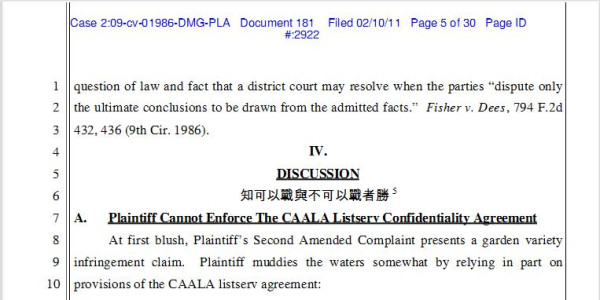
How about references to the quotations of historical figures which have withstood the test of time (in this case Sun Tzu)?
The judge referenced in the Globe and Mail article changed his writing style to be "more accessible." Here's an example:
And in a murder case last year, R v Simon, Judge Watt commenced: "Handguns and drug deals are frequent companions, but not good friends. Rip-offs happen. Shootings do too. Caveat emptor. Caveat venditor. People get hurt. People get killed. Sometimes, the buyer. Other times, the seller. That happened here."The article includes a few other examples as well.
There is no requirement that judicial opinions be dry. In fact, there are many judges whose opinions are a pleasure to read because the are the opposite of dry (e.g., Judge Kozinski). (These judges would probably all make good bloggers as well I'm guessing.) Good writing also helps the author make his or her point and judges are no different. However, at a certain point, prose can be overly indulgent, and if the judge is merely writing to demonstrate how clever he or she is, this is a disservice to the litigants and the public. There's also the point (made by Prof. Tanovich, a law clerk for former Supreme Court of Canada Chief Justice Antonio Lamer) that an opinion that is sarcastic or glib can "sensationalize and desensitize" tragic events that are the subject of opinions.
The article does not mention pop culture references but these are particularly problematic. These are the worst form of indulgences in court opinions. The judge is obviously citing the reference to show that he or she is "hip" or "with it." Pop culture references mean different things to different people, and are surely lost on people who aren't tuned in to pop culture. (Last year someone cited in a blog post to a Texas Supreme Court opinion which referenced Star Trek II: The Wrath of Khan. It was cute, and received attention in certain circles, but what if the litigants were not treekkies?) An opinion containing pop culture reference will also not stand the test of time. Justin Bieber may be popular now, but he may turn out to be unknown hundred years from now, and if you drop a reference to him in your opinion, people who are reading a hundred years from now may have no clue as to what you are talking about. (OK, this particular example isn't a great one, but . . .)
How about references to the quotations of historical figures which have withstood the test of time (in this case Sun Tzu)?
About the Author

(@VBalasubramani)
